Monday, February 27, 2017

Deep Decline


Nearly all the pictures I post on this blog were taken by me or my husband. But this one is from Scott McGarvey. He and his wife Suzi also worked in Jordan. A couple of times, our appointments to Jordan overlapped theirs and we were able to minister with them.

This road is not for the fainthearted, that is for sure!

Monday, February 13, 2017

Lost in Translation - Jordan

In Jordan, when words are translated into English, they are often misspelled. I'm not being critical, though; their English is better than my Arabic!

See if you can spot the mistranslations. Have fun!

Monday, February 6, 2017

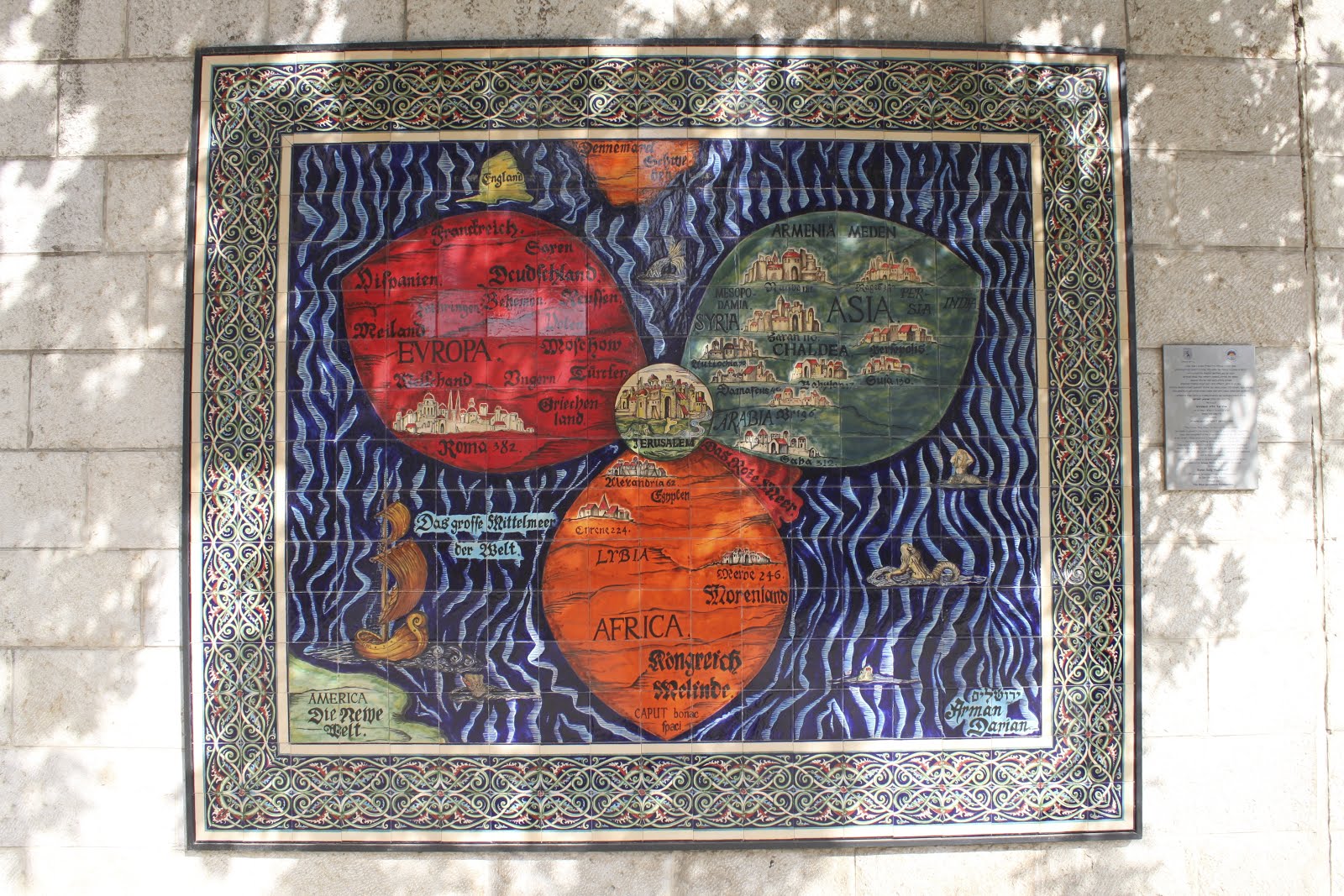
The Clover Map


The following explanation was on a plaque beside the artwork:

"The Clover Map, drawn by Heinrich Bunting in 1585. Jerusalem is placed in the center of a large three-leaf clover resembling eyes, also comprised of the three continents of the old world. In the artist's vision, Jerusalem is depicted as a city of large structures and fortresses, as befitting an important and central city. Then, as now, Jerusalem shines forth like a precious jewel, drawing in nations, wishing to bask in her light, enjoy her beauty and dwell in her holiness. In due time she will serve as a beacon of peace to her neighbors and to the entire world."

Designed and created in ceramic with traditional elements by the Jerusalem artist, Arman Darian, Safra Square, Jerusalem

Monday, January 30, 2017

IDF


The IDF (Israel Defense Forces) is comprised of both men and women who fulfill obligatory military service. Both men and women serve after the age of 18, men for at least 2 years and 8 months, and women for 2 years. Israel is the only country in the world that mandates women to military service. Because of its small population, Israel has a small standing army but most of the population are reservists until the age of 40. 

The guys above were kind enough to allow us to take their photo, at my mother's request. I took the photo below somewhere along the road between the northern Jordan/Israel border crossing and Tiberias. Soldiers waiting at bus stops is a common sight in Israel.


Saturday, January 21, 2017

Smile a While

My husband and I saw this "good graffiti" as we were walking along a path in Beit Zayit, a community in central Israel. At times, we all need a reminder to smile. After all, there is a lot more to smile about than frown about. Smiling makes life seem a bit more manageable, regardless of where you are in the world!

Monday, January 16, 2017

Jordan River Miracle


I really like reading II Kings 6:1-7. It is a miracle that combines the practical with the spiritual.

Here you have Elisha’s protégées who want to relocate, probably because there were more prophets-in-training than there was room to house them. So they all go to the Jordan River and cut down nearby trees to build a new home.

While one guy is working, his axe head falls into the Jordan River. He is dismayed because he had borrowed it.

Now, we are not talking 21st century America with a Home Depot nearby with a big supply of axe heads. At that time, an axe head would have cost a lot of time to make and was not easily replaced.

It is one thing to lose something of your own, but it is quite another matter to lose a valuable object that does not belong to you.  

Elisha did not blink an eye, but caused the axe head to rise to the surface of the water by throwing a stick into the water. 

How did the stick cause the axe head to float? I don’t know. That is why we call it a miracle. 

The Holy Spirit (God in action) should affect the practical aspects of our daily lives. When we are involved in even the most mundane chores, the miraculous is never far away!

Monday, January 9, 2017

Compliments

I knew better. Really. But I forgot. 

My husband was giving a Bible study in an Arab village. We were in the translator's home and I was discreetly looking around the room as the men were talking among themselves. I noticed a beautiful cross stitch on the wall. Many Arab women make cross stitches to decorate their homes. 


I told Walid, our translator, that I liked the cross stitch and he said his wife had made it. I told him it was beautiful. I went through a phase where I cross stitched and know how long it takes to make one. This one was pretty with a Scripture written in Arabic script. Using sign language and smiles, I let Hala know that she had done a lovely job on her cross stitch. 

In America, if you compliment someone on their clothes, car, or something in their home, it is polite. In fact, some people leave unique things on their coffee tables as conversation pieces. Americans like to be complimented on their belongings. 

In the Arab world, however, complimenting someone on a possession is a HUGE no-no. They will think that you want that item! And, often, they will give it to you. 

A few weeks after I complimented Hala's cross stitch, her husband brought me a little bag. (Hala could not speak English and I could not speak enough Arabic to hold a complete conversation, so her husband translated for us.) Inside the bag was a cross stitch pattern, canvas, and thread that matched the cross stitch on Hala's wall. She had gone to the trouble to go get all those items for me just because I complimented her cross stitch. 

It was a reminder to me to be more culturally aware and sensitive. What is acceptable in America is not necessarily acceptable everywhere else. When in Rome...

I was just glad Hala had not given me the finished cross stitch. That really would have caused me to feel bad about my cultural misstep!