Wednesday, December 9, 2020

Photos of Rosh Pina


Rosh Pina

One of our favorite places to visit when we are in northern Israel is Rosh Pina. The old neighborhood, founded in 1882, is on top of a hill. It is a quaint collection of sturdy stone buildings. These restored structures are now homes, restaurants, and art galleries. There is also a synagogue, which was the first public building erected in Rosh Pina. 

This quiet village is never busy or overcrowded when we visit and we always enjoy walking along its meandering cobblestone streets and through the nearby park. The clean, fresh air and natural setting is refreshing. Down the hill is the modern area of Rosh Pina, still very nice. There you find shopping centers and more restaurants. 

Rosh Pina has quite a few zimmers (guest houses) but we usually stay in Amirim when are in the Galilee region of Israel. So, we just go to Rosh Pina to visit for a few hours and to enjoy a good Israeli meal.   

Rosh Pina received its name from Psalm 118:22, which says, “The stone which the builders refused is become the head stone of the corner.” Rosh Pina means “head of the corner” or “cornerstone.”

Although Rosh Pina does not appear to have a link to a biblical city, its name indicates that its early Romanian-Jewish founders desired to build something lasting. They succeeded, for the stone structures they erected so long ago are now highly prized real estate, valued for their stability, ambiance, and historical significance. 

There is a simple yet powerful lesson we can learn from the name of this village. In the world of architecture, the cornerstone is the first stone that is laid. All other stones are laid in reference to the cornerstone. A cornerstone determines the direction in which a structure will be built.

Jesus referenced Psalm 118:22, revealing Himself as the stone which the builders rejected (Matthew 21:42; Mark 12:10; Luke 20:17). Many people foolishly reject Jesus. As a result, their lives are unstable and lack God-ordained purpose.

To Christians, Jesus Christ should be our cornerstone (Ephesians 2:20; I Peter 2:6-7). He is the one who we should build our lives on. He will determine the direction we should go. He is solid and stable and trustworthy.

We must always be cognizant of the value of Jesus Christ being the cornerstone of our lives. We should not reject Him but rather invite Him to set the course for our lives. As we contemplate what we should talk about, think about, and what we should do, we should always look to Jesus and never the world as our reference point as we erect the structure of our lives. This will guarantee that we are building something worthwhile that will stand the test of time.

Rosh Pina – Cornerstone – is a lovely place to visit. But even more lovely is a life well built upon Jesus Christ, the Chief Cornerstone. 

Monday, September 30, 2019

New Website

We recently created a new website. You are welcome to check out www.magnifytheword.com. Hope you enjoy it!

Wednesday, May 22, 2019

Mazkeret Batya

Last year, my husband and I had a long layover in Israel as we were on our way to Cyprus. For two nights, we stayed in a Jewish community called Mazkeret Batya. We arrived during the day, so once we settled into the small, simple room in a little hotel called Hapina Shel Michal on Rothschild Boulevard, we jumped back into our rental car. We drove to Jerusalem, where we met some friends for dinner at Focaccia. 

The next day, we explored quiet residential Mazkeret Batya, which is located about a 20-minute drive south of Ben Gurion Airport. This "village" is home to about 10,000 people, but its beginnings were not only humble but historic. 

The First Aliyah is a term that refers to the first influx of Jews into Israel in modern times. The First Aliyah occurred between 1881-1903. Mazkeret Batya was born during this First Aliyah. 

Baron Edmond (Binyamin) de Rothschild funded this settlement, along with 27 others. His father's name was Jacob and his mother's name was Batya. The village was originally named Ekron but the Baron renamed it Mazkeret Batya in honor of his mother. 

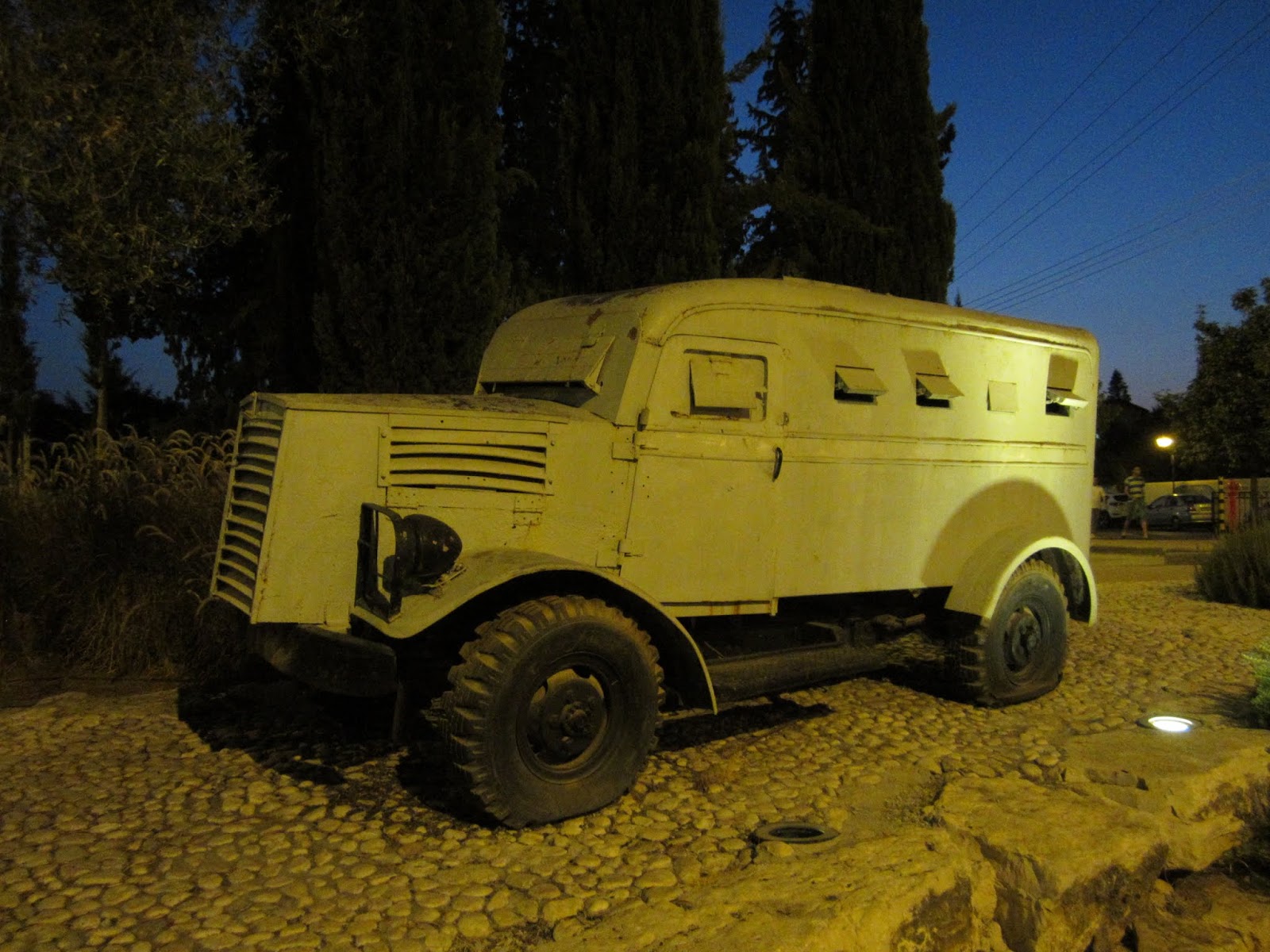
Mazkeret Batya began as a farming community of Religious Zionists. One important historical note linked to Mazkeret Batya was that during the Jewish War of Independence, convoys departed from this village to besieged Jerusalem. An old truck is displayed in the village as tribute to this community's contribution to the War of Independence. 

In general, we did not find the inhabitants in Mazkeret Batya particularly friendly. The guy at the bread store had little interest in telling us about his products and prices. Young people staying at the hotel were not interested in making conversation with us. 

But the proprietress at the hotel was helpful. Also, we ate for the first time at a Burgerim in the village and the young men working there were very friendly and conversational. (By the way, I had a salad at Burgerim and it was delicious but my husband did not at all like the burgers!)

Plus, at one point, during one of the times when we got lost driving amid Mazkeret Batya's winding lanes, we asked a Jewish family for directions. They led the way back to the hotel, with us following behind. We were quite grateful for their assistance! 

So, despite the fact that some of the people were standoffish, there were enough who were friendly to compensate for the others. :) 

One evening, we were browsing a grocery store. Nothing interesting about that. But after we purchased some crackers, I headed to the exit door. I heard people yelling, but at first I did not know they were yelling at me. (My Hebrew is fairly limited.) Turns out I was about to exit through a door that would have set off an alarm. Just in time, I realized what was happening before I created a small crisis!

Hapina Shel Michal in Mazkeret Batya was a convenient place to stay during a long layover because it was close to the airport and was much less expensive than other hotels. But unless I had another long layover, I would probably not stay there again. There is not enough to do in Mazkeret Batya to warrant an extended visit. 

With that said, however, I really enjoyed the glimpse into history that our brief visit gave us. And it was a good, quiet place to rest after a very long flight from the United States!


Wednesday, May 8, 2019

New Music CD - "The Captain"

As many of you know, for some time now, Bill has been working on producing a music CD called "The Captain." It will be released very soon!

You can preorder your copy of "The Captain" HERE.


Saturday, September 15, 2018

Cyprus: Initial Thoughts

We have now been in Cyprus for over two weeks. I want to share with you some my reflections of this country but I don't quite know where to begin. As time goes on, I will post photos and give more details. Here are a few of my observations so far. They are a bit random, but that is okay for now. 

My preliminary opinion of this island nation is that it is both similar and dissimilar to Jordan and Israel, where we have worked before. The climate is similar: hot, dry, and dusty. The terrain is also reminiscent. Here are rocky hillsides, mountains and, of course, the Mediterranean Sea, which Israel shares. 

The language, of course, is different. In Jordan we heard Arabic and in Israel we heard Hebrew, Arabic, and even Russian. In the southern part of this country, Greek is spoken. In the North, which we visited yesterday, Turkish is the primary language. 

We live in a lovely village called Pervolia, near Larnaca, a larger city. The airport is not too far from us and planes frequently fly overhead. The other day, because WiFi had not yet been installed in our apartment, I took my laptop outside to connect to WiFi in another part of the building. I Skype-called my parents and every few minutes I had to pause the conversation because the planes overhead were so loud. Inside, however, they are not loud at all and do not disturb us. 

The main religion of southern Cyprus is Greek Orthodox. The main religion of northern Cyprus is Islam. We live in the southern area and the influence of the Greek Orthodox Church is everywhere. They have their fingerprints on a lot of things, from government to real estate. There are old churches and monasteries everywhere, many of them Greek Orthodox. There is an intense division between the Greek Orthodox Church and the Catholic Church. Maybe I will discuss some of the reasons for that later. Although many people are not devout, they are still loyal to the Greek Orthodox Church. Tradition is the tie that binds.  

There are a lot of British people in Cyprus. Some live here permanently. Others have second homes here. There are a lot of British products in the supermarkets. The terminology differences between American English and British English are quite apparent here. For example, what we call an apartment they call a flat. What we call French fries they call chips. We call the storage compartment in the rear of our cars the trunk. They call it the boot. A stove is a hob.

The food. I must admit that I was expecting the diet to be Mediterranean. And it is. Kind of. A lot of the same foods grow here that grow in Jordan and Israel. Dates. Figs. Pomegranates. Olives. Yum. Foods I really like and that definitely fit the "Mediterranean Diet" profile. But here in southern Cyprus people eat a lot of meat, especially pork. If you know me very well, you know that I dislike pork. Of course, in both Jordan and Israel, pork is hard  to find and if you do find a store that sells it, it is expensive. But here I am finding ways to deal with meat-heavy menus. There is nearly always a Village Salad on menus, which is greens, cucumbers, tomatoes and maybe cheese lightly dressed with olive oil. Some restaurants have vegetarian options. And in the markets there is no shortage of vegetables, which are super-fresh and very cheap. So we have been eating a lot of vegetables in our apartment, er, I mean, our flat!

Hope you enjoy this brief introduction to Cyprus from an American point of view. More to come soon!

Monday, July 30, 2018

Ketef Hinnom

This is Ketef Hinnom, where tiny silver amulets were found, upon which were inscribed the Priestly Benediction. One of my favorite places in the Holy Land!