Tuesday, January 10, 2012

Martha's Dilemma


Luke 10:38-42
"Now it came to pass, as they went, that he entered into a certain village: and a certain woman named Martha received him into her house. And she had a sister called Mary, which also sat at Jesus' feet, and heard his word. But Martha was cumbered about much serving, and came to him, and said, Lord, dost thou not care that my sister hath left me to serve alone? bid her therefore that she help me. And Jesus answered and said unto her, Martha, Martha, thou art careful and troubled about many things: But one thing is needful: and Mary hath chosen that good part, which shall not be taken away from her."

When the story of Mary and Martha is talked about, Martha often gets slightly berated for her failure to sit at Jesus’ feet. It is tempting to simplistically conclude that Mary was spiritual and Martha was carnal. While Mary wanted to listen to Jesus, all Martha was interested in was doing.

Mary gets the star and Martha has to sit in the corner of the room. We figure that it is better to pray than cook for the potluck supper, and spiritual things always trump natural things. While there certainly is truth in this, there is a much deeper dynamic and lesson here that few people realize.

Beyond the simple spiritual-versus-carnal lesson, I think Jesus was trying to teach two less obvious principles that we can apply to many areas of our lives and which shed light on the spiritual-versus-carnal concept: 1) Sometimes it is okay to break free from cultural norms and 2) Misplaced priorities can be detrimental.

According to cultural norms, Martha was doing exactly what was proper: She was serving her guests. To do otherwise would have been a terrible slight to visitors. In Martha’s society, failure to prepare food and drink for guests was unthinkable. Her womanhood was defined in great part by her ability to serve her family and guests.

During our time in Jordan, we spent a lot of time in people's homes. I do not remember one instance of being in a home where we were not served food (usually fruit or cookies) and drink (usually tea or juice). Middle Eastern women are such gracious hostesses that I feel quite clumsy by comparison. The picture above features Umm George, or Mother of George (her eldest son). She and her family do not have a lot materially but they are generous with what they have.

When Martha asked Jesus to tell Mary to help her, she was appealing to their society’s inbred understanding of a woman’s place in their culture. Their proper role in society dictated that women take care of the home and children. Even today, in Jordan, few women work outside their homes. Even if you walk into a women’s clothing store, nine times out of ten you will find a man serving as the clerk, not a woman. Although a few women work in grocery stores and hospitals, it is understood that these are exceptions to the norm.

Then as now, as a traditional woman living in the Middle East, it was unacceptable to mix with men. Many of the homes we visited were guided by this rule. To a great extent, men fellowship with men and women fellowship with women, sometimes even in separate rooms.

When Mary opted to sit at Jesus’ feet instead of helping Martha in the kitchen, she became a woman in a man’s world. By entering a room full of men, as though she was one of them, she removed herself from her proper role in society. So, although we understand that we should be like Mary and not Martha, there is more here than at first meets the eye.

Jesus was trying to help people understand that sometimes the gospel contradicts culture. And when it does, we must follow the gospel. In this case, although what Martha was doing was entirely right, there was a higher law at work here. Mary discovered that “good part.” She somehow realized that her acceptable role could be set aside for a higher way of life. While Mary instinctively understood this, Martha had to be taught it.

Jesus invited “whosoever will” to follow Him (Matthew 8:34). Anyone and everyone – male or female, Jew or Gentile, poor or rich – was welcome. Jesus did not validate the barriers in His society. In fact, during His ministry, Jesus was constantly uprooting traditions and unseating cultural norms. He fought against deeply rooted mindsets. Some of the mindsets, in and of themselves, were not necessarily evil. But when they caused people to be stuck in a rut, Jesus referred them to a higher way of life.

When Jesus told Martha, “You are careful and troubled about many things,” He was letting her know that her problem was her adherence to cultural norms when something more important was occurring. Although she was doing what was right and proper, she failed to recognize that there was a higher law trying to work in her life. Note that nowhere in the passage did Jesus actually condemn Martha for her hospitality and service. He only pointed out her misplaced priorities, which were causing her to be agitated and upset. It is okay to do as long as our deeds are motivated by pure love for Jesus.

We can learn a lot from this passage. Sometimes we feel so compelled to mirror the customs and mindsets of our society. We feel pressured to conform. As our world gyrates with change, from modesty limits in clothing styles to the acceptance of once shunned sins, we are bombarded with pressure to follow their trends. Because we are Americans, we do American things and we think like Americans. We never pause to consider that our loyalties to American culture should be far exceeded by loyalty to our King who rules a nation far superior to America or any other earthly country.

Some things about America are not necessarily evil but our adherence to them can inadvertently cause us to have misplaced priorities. For example, America was built on principles of hard work, entrepreneurship, and solidarity. These are some of the concepts that made America great. Here, you could become almost anything you wanted to become. Dreams could become reality.

Whereas these principles are not evil in and of themselves, for some they could become detrimental. A man could become a workaholic and neglect his family, creating insecurity and resentment among them. An entrepreneur could become so focused on making his business successful that he fails to spend time in prayer and misses church services to work late, eventually becoming spiritually lukewarm.

We must dedicate ourselves to keeping the Kingdom of God in sharp focus. It will not happen automatically. In the Old Testament, God warned His people against assimilation (Leviticus 18:26-27; Deuteronomy 18:9; 12:29-31). You will live among them but don't worship their gods, He said. Don't follow their customs. Blending was never acceptable.

When we try to fit in with the world around us, we are attempting the impossible. We are simply not one of them. We are peculiar, or special, people (Titus 2:14). We are a holy, or separate, nation that has been called out of darkness (I Peter 2:9). We might be Americans, but we are also citizens of a greater nation. When choices have to be made, our loyalty to our heavenly home surpasses our earthly home. Sometimes we will have to completely abandon certain activities and concepts. With other things, we will just have to keep first things first. As it was not wrong for Martha to serve, so some things will not be wrong for us to do, as long as our priorities and motives are right.

Mary was misunderstood by her sister Martha. When we go against the status quo and break free from cultural norms, we should expect to be misunderstood, even ridiculed at times. Until onlookers break free from the kitchen and enter the presence of Jesus, they simply will not understand the beauty of things they find so repulsive.

Just as Jesus admonished Martha to readjust her priorities and lay aside her innate habits that were so comfortable to her, He sometimes asks us to do the same. When we must make a choice, our guiding charter must be the Bible and the principles of the Kingdom of God. It is a higher law, a superior way of life.

Wednesday, January 4, 2012

The Place of the Skull


I come down one road. You come down another. We all meet at the foot of the cross.

The title of an old song is “The Ground is Level at the Foot of the Cross.”

At Calvary, Golgotha, the Place of the Skull, we are all the same.

When we understand Calvary, we forgive. When we view the blood streaming from a broken body, we love. When we hear the women crying, we have compassion. Calvary enables us to overlook faults, because love covers a multitude of sins.(1) Calvary is our greatest example of suffering, sacrifice, giving beyond what a human being seems capable of giving. Jesus gave everything. He gave all He had to give. There was nothing left.

Calvary, oh what it means to me.
Since Jesus set me free, I think of Calvary.
Jesus’ blood, oh what a cleansing flood.
He did it all, for me, on Calvary.(2)
Whenever I am tempted to lift myself up, I need to kneel down…at the foot of the cross, where the ground is level.

Part of me wants to look away from Calvary, pretend it didn’t happen. I don’t like to read the last chapters of the gospels that detail the trial, the beating, the crucifixion of this man named Jesus. It is repulsive. “We hid as it were our faces from him.”(3) He was despised. We didn’t want to look! What an ugly sight. Why did He do it? Why? Why? Why?

He did it all for me…on Calvary.


References:
1. I Peter 4:8
2. Song Lyrics, “Calvary,” Brooklyn Tabernacle Choir, Giving Him Thanks, 1981
3. Isaiah 53:3

Monday, December 5, 2011

Bethlehem


As Christmas approaches, our thoughts turn to Bethlehem, where our Messiah was born. I decided this was a good time to reflect on our visit to Bethlehem earlier this year. My mother-in-law, Bea, was with us and foot the bill for our expensive taxi ride. We appreciate her helping us see some sites, including Bethlehem, that we would not have been able to visit otherwise. (Since we operate on a fixed budget when we work overseas, we have to carefully monitor our finances, and we do not do a lot of sightseeing that requires a lot of additional funds.) I hope you enjoy reading this blog article: my analysis of Beit Lechem - then and now. Merry Christmas!!!

“Oh little town of Bethlehem, how still we see thee lie…” This traditional Christmas carol evokes soothing images of stillness, peace and rest. The song makes me think of a Thomas Kinkade painting depicting a quaint little Bavarian-style village. Warm light spills from the windows of cozy cottages, beckoning weary travelers, inviting them to be refreshed by the serenity of a perfect world.

In reality, the modern town of Bethlehem has little tranquility to offer. Currently, Bethlehem is a town politically divided. The population of 30,000 is a blend of ethnicities and religions, with Palestinian Muslims now taking the population lead. The constantly shifting political atmosphere produces an unstable environment in Bethlehem. No one – regardless of ethnicity or religion – is insured a safe haven in the not-so-little town of Bethlehem.

Even when Jesus was born, Bethlehem’s inhabitants probably did not live with a sense of perfect security. After all, Herod, an unpredictable and paranoid madman, ruled over their lives. He didn’t flinch at ordering the slaughter of children in Bethlehem two years and younger, in his attempt to destroy Jesus.

Like most of Israel, the buildings are constructed of stone, close together, in a peg-leg style along the sides of hills. And like many ancient biblical cities, Bethlehem sits atop a winding ridge. It is hilly country, green enough for shepherds to keep their flocks supplied with adequate pasture. Bethlehem is a mere five miles south of Jerusalem. In biblical times, it was within the boundary of the tribe of Judah.

What English-speaking people call Bethlehem is Beit Lechem in Hebrew. It means “House of Bread.” The Arabic pronunciation is similar – Bet Lahm – and it translates to mean “House of Meat.” In the Bible, “bread” and “meat” are often generic words that simply mean “food.” Simply, the overall meaning of Bethlehem is “House of Food” with an unstated special reference to grain and bread. An example of Bethlehem’s grain industry is seen in Ruth 1:22. Ruth and Naomi arrived in Bethlehem in “the beginning of barley harvest.”

Bethlehem was also called Ephrath (Ge 35:16,19; 48:7), Ephratah (Ruth 4:11), Bethlehem Ephratah (Micah 5:2), Bethlehemjudah (Judges 17:7-9; 19:1-18; Ruth 1:1-2; I Samuel 17:12), and the City of David (Luke 2:4,11).

I suppose my visit to Bethlehem was a bit jaded from the start. I wanted to visit the town but I had repeatedly been told that Bethlehem was not the dreamy town of manger scenes and cute Christmas plays. Not only is this historic town rife with political dissent, it is also monopolized by religious groups who cater to tourists’ inclination to gravitate to sacred and supposedly-sacred places. Tourists, Christian clerics, Arab merchants, and taxi drivers all make for quite a colorful – and slightly chaotic – crowd.

Since Jewish rental cars cannot be driven into this Palestinian-controlled area, my mother-in-law hired a taxi to take us to Bethlehem. Our pass through the Bethlehem checkpoint was a breeze, thanks to our taxi driver and checkpoint personnel who took one quick glance at us and decided we did not look too threatening. Once in Bethlehem, our taxi driver pulled up to a hotel, not our destination. Turns out he thinks we need a guide…one of his friends. We don’t want one but it takes a while to convince them of our decision.

Manger Square is dominated on one side by the Mosque of Omar and on the other side by the unembellished Church of the Nativity. This church is a hodge-podge blend of architecture. Three different religious orders are allocated space in this building: the Greek Orthodox Church, the Roman Catholic Church, and the Armenian Orthodox Church. We bent low as we entered through the undersized door of the threshold. The dimly lit, stone-lined central room was supported by Corinthian columns and adorned with various religious icons, wall murals, and garish chandeliers.

A long line had formed to the right. An unofficial Arab guide approached us and told us that the people were waiting their turn to view the traditional place of Jesus’ birth. He forcefully offered to help us, and we soon learned that he was skilled at edging his way into the crowd. It was not our idea of making friends and influencing people. But by this time we were committed, so we followed him as he wormed his way into the mass of tourists. It reminded me of public grade school children cutting into a long lunch line, eager to get their favorite government-issued meal.

Rather than a slice of pizza or sloppy Joes, however, everyone was eager to view the place where Helena declared that Mary had given birth to Jesus. With our “guide” beside us, we merged into the crowd, following a group of men in black suits; I assume they were monks. At one point they broke into singing, in Latin, I presume. After inching through a narrow hallway, where wax from overhead candles dripped onto one of my favorite sweaters, we reached our destination.

Over a grotto that is under the jurisdiction of the Greek Orthodox Church, a 14-pointed star adorns the marble floor of a dimly lit altar. No one seems to know why there are 14 points on the star, but the most plausible explanation is that the number 14 represents the 14 generations between Abraham and David, as well as the 14 generations between David and Jesus. At this place that allegedly marks Baby Jesus’ delivery room, people bent to kiss the star on the floor. We declined the kissing procedure, preferring to simply pause briefly to view the décor and engage in some people watching.


Several notable Bible figures – Rachel, Ruth, and David – have connections to Bethlehem.

Rachel was Jacob’s beloved wife. She was buried near Bethlehem (Genesis 35:19; 48:7). A tomb commemorates her death and women go there to pray for safe pregnancies.

Ruth, a woman from the land of Moab, married a man from Bethlehem who had moved to her land with his mother, father, and brother to escape a famine in the land of Judah. Ruth’s husband died and she traveled to Bethlehem with her mother-in-law Naomi, who had also become a widow. It was in Bethlehem that Ruth married another Bethlehem native, Boaz. Ruth and Boaz were David’s grandparents. Ruth and Boaz are also listed in the genealogical account of Joseph, Mary’s husband. Since genealogical records were not kept for women, but men only, this provides a legal record of Jesus’ earthly ancestral line (Ruth 1:1-22; 4:13; Matthew 1:5; Luke 2:4; John 7:42).

Bethlehem was David’s hometown. It was here that he was anointed king by the prophet Samuel. It was on the hills of Bethlehem that he guarded his father’s sheep, cultivated his ability to use a sling, and killed a bear and a lion to protect the sheep. Samuel, at the command of the Lord, traveled to Bethlehem to anoint David king of Israel (I Samuel 16:1-13).

One of the more interesting sites in Bethlehem is one of the most obscure. King David’s Wells are three cisterns that were discovered in 1895. They are surrounded by a low metal gate. Since we did not know that the wells could be reached by walking just a short distance from Manger Square, we opted for the long way. (That seems to be our trend, since we serve as our own tour guide!) We climbed up an entire hillside of steps, hurrying since the taxi driver was waiting for us. The wells, which were located on the property of a Catholic school, were deserted. We opened the unlocked gate and let ourselves into the site.

Why are these wells significant? Even though it is unknown if these wells have a biblical connection, it is tempting to imagine heroes from David’s army furtively drawing water from them.

When David was in hiding, trying to preserve his life from Saul’s wrath, he longed out loud for a drink of water from Bethlehem’s well: “Oh that one would give me drink of the water of the well of Bethlehem, which is by the gate!” Then as now, Bethlehem was a city in conflict. The Philistines had invaded the area and taken control of David’s hometown, turning it into a battle zone. Three of David’s loyal warriors broke through the enemy lines and brought David precious water from the well. David was so overwhelmed by the loyalty and courage of these mighty men, he poured the water out onto the ground (II Samuel 23:14-17; I Chronicles 11:16-19).

Saturday, November 12, 2011

Yom Kippur


At Timna, in southern Israel, is a reconstruction of the Tabernacle in the Wilderness. To the left is a picture of the outside of the tabernacle. The Ark of the Covenant, covered by the Mercy Seat, was in the Most Holy Place.

Guest Blogger: Imelda Quibin

Yom Kippur, the Day of Atonement, is the sixth of the seven Feasts of the Lord. According to the Jewish calendar, Yom Kippur falls seven days after Rosh Hashanah (the Jewish New Year).

Old Testament References

Leviticus 16 is about the Scapegoat. “And Aaron shall lay both his hands upon the head of the live goat, and confess over him all the iniquities of the children of Israel, and all their transgressions in all their sins, putting them upon the head of the goat, and shall send him away by the hand of a fit man into the wilderness. And the goat shall bear upon him all their iniquities” (Leviticus 16:21-22).

“And the Lord spake unto Moses, saying, Also on the tenth day of this seventh month there shall be a day of atonement: it shall be an holy convocation unto you; and ye shall afflict your souls, and offer an offering made by fire unto the LORD. And ye shall do no work in that same day: for it is a day of atonement, to make an atonement for you before the LORD your God” (Leviticus 23:26-32).

Many verses, especially in Leviticus and Numbers, taught the children of Israel how to strictly observe the Day of Atonement. It was a day of contrition, repentance, a day for sins to be atoned by God.

(Sylvia's Note: "Yom" is Hebrew for "day." The root word of "Kippur" means "to cover or hide." It also means "to obliterate." A similar Hebrew word is "Kapporet," which means "Mercy Seat.")

Current Jewish Practices on Yom Kippur

Yom Kippur is a solemn day of fasting. When my employer hears the word "Latsum" (the Hebrew word for “fasting”), she automatically responds, “I’m exempt!” Old people, young children, and servants are exempt from fasting.

Public and private vehicles are not seen on the streets, aside from police and medical emergency vehicles.

Nowadays, each religious sect of Jews observes the Day of Atonement differently. My employer is a 96-year-old non-observant Jew from Europe. She is Ashkenazi by origin. She cannot move from her house to the synagogue so an older family member comes to her home. He brings very old coins, maybe from their ancestors. He puts the coins in a plastic bag and waves them over the head of my employer as he recites some prayers.

I asked my employer’s granddaughter, “Why coins?” She explained to me that they do this to ask God’s forgiveness. She said that God’s forgiveness cannot be bought for any amount of money. That is very true; we can't bribe the LORD JESUS.

Some ultra-orthodox Jews like Haridim perform the "kapparot" ritual, synonymous to that of the scapegoat. They wave a live chicken over the heads of their loved ones to transfer the individual's sins to the animal. The chicken is then slaughtered and donated to the poor, or the family shares it. (Some people, like my employer, use coins instead of a chicken.)

Jesus Christ as the Atonement
“So Christ was once offered to bear the sins of many; and unto them that look for him shall he appear the second time without sin unto salvation” (Hebrews 9:28). What a great promise LORD JESUS! We do not have to receive atonement for our sins every year but we are washed completely by your precious BLOOD. We just have to repent of our sins, and continue in our walk with Him until His second appearing, as the above verse implies. There are many other verses in the Scripture about the Atonement; even the prophet Isaiah prophesied about this.

Friday, November 11, 2011

Yom Kippur, 1973


In 1973, Syria from the Northeast and Egypt from the South, backed by other Arab countries, invaded Israel on Yom Kippur. They took advantage of the one day of the year when nearly all Israelis would be indoors, resting, fasting, and praying. Many soldiers left their posts to spend the day with their families. Public transportation and broadcasting were shut down in observance of that day. However, some analysts believe that the surprise attack was to the Israelis' advantage. The roads were clear to mobilize forces and broadcasting was free to focus the public's attention on the conflict. The war lasted just under three weeks, from October 6 to October 25. In the end, Israel resisted the invasion and pushed back the Arab forces.

We visited Mount Bental in the Golan Heights. This was a strategic point during the 1973 war. As Syria tried to invade their land, the Israelis defended Mount Bental. The Syrians had 1,500 tanks to Israel's 160 and 1,000 artillery pieces to Israel's 60. The battle was brutal and casualties were high but in the end, Israel still controlled the Golan Heights. Between Mount Bental and Mount Hermon to the north is a long valley. It came to be called Kuneitra Valley, or Valley of Tears.

The Israelis overtook the Syrian town of Kuneitra during the war in the most interesting way. On the final day of the war, a Syrian broadcast announced that Kuneitra, the Syrian headquarters for the area, had fallen to the Israelis. It hadn't, but the Syrian soldiers didn't know that, so they retreated further into Syria. The Israelis then captured Kuneitra without a fight. A ceasefire was called and the Yom Kippur War officially came to an end. What remains of Kuneitra lies in a demilitarized zone between the two nations.

Interestingly, Paul's dramatic encounter with the Lord on the Damascus Road is traditionally believed to be in Kokab, a village to the northeast of Kuneitra.

We walked through the old bunkers and trenches, some of them pockmarked, mute reminders of the blood that was shed in this area in October of 1973.

The view from the top of Mount Bental is beautiful. On a clear day the observant eye can see far into the distance. A weathered signpost points to regional cities - Damascus, Amman, Baghdad - and tells the distance to those places. A United Nations compound in the valley is easily observed. They are there to maintain the sometimes volatile, paper-thin relationship between Israel and Syria.

On top of Mount Bental, it is easy to understand why the Israelis founght so hard to retain the Golan Heights. They are a formidable mountain range, a natural defense barrier, a protective wall.The Golan Heights are towering mountains of rock which rise steeply and immediately from the valley floor. I am a far cry from a military analyst, but after seeing the terrain, I presume that whoever holds the Golan also controls the area around it, and that is what makes the Golan Heights worth dying for.


Wednesday, November 9, 2011

A Rose-Red City - Part Five (Final)


Petra: Past, Present, and Future
Petra is one of the New Seven Wonders of the World. Its eclectic blend of architectural styles, combined with the sheer wonder of its creation, make Petra an amazing place to visit. In 1993, King Hussein of Jordan said, “Petra is a stunning physical monument from ancient times, but it is also much more than that; it is a timeless message that speaks to us still of an eternal human capacity to dare, and therefore to achieve bold feats and beautiful wonders.”

John William Burgon, a British theologian, is remembered by history as a fierce opponent to Westcott and Hort, the two men chiefly responsible for the revision of the King James Version of the Bible. But Burgon also went down in history for his poem simply entitled Petra. Though he never visited Petra, he formulated his poem from explorers’ descriptions. The poem’s famous line describes Petra as “A rose-red city – ‘half as old as time.’”

Petra’s past connections to the land of Israel – from the Edomites to the Nabateans – have definite and important biblical links. Today, Petra serves simply as a tourist attraction. Even the Bedouins that once lived in some of Petra’s many caves have been relocated to nearby desert housing. But some people believe that Petra is only lying dormant, until it is once again inhabited. It is possible that Petra might be where the Jews will flee during a time of future tribulation. Prophecy students refer to verses such as Matthew 24:16, Isaiah 33:16, Jeremiah 49:13-14, and Micah 2:12-13 to back their supposition. Prophecy is one topic I have little interest in, so I am highly unqualified to comment on this idea. But I do know that Petra is a natural stronghold, an excellent defensive position. If I needed to suddenly escape from Jerusalem, I might head for Petra. As the crow flies, the two cities are only about 100 miles apart.

Regardless of what the future holds for Petra, its past holds many lessons for us today. We simply need to read the records of Esau, Doeg, Herod Antipas, and others. Unfortunately, it is their mistakes that provide our lesson material. But, if we take heed to their errors, we can take a different path than they chose. Past the din of tourists’ voices and camels’ bellows, Petra’s rose-red walls echo a message: "Learn, glean...remember."


A Rose-Red City - Part Four


Paul and Aretas IV

In II Corinthians 11:32-33, Paul recounts that “In Damascus the governor under Aretas the king kept the city of the Damascenes with a garrison, desirous to apprehend me: And through a window in a basket was I let down by the wall, and escaped his hands.”

Acts 9:1-27 gives us more background and explanation to Paul’s explanation in II Corinthians. Damascus, Syria is the setting of Paul’s dramatic conversion experience. There Paul’s physical and spiritual eyesight were restored. He was filled with the Holy Ghost and baptized. He did not immediately return to Jerusalem but he stayed “certain days with the disciples which were at Damascus.” The gospel is powerful, and overnight Paul went from a persecutor of the gospel to an evangelist promoting the gospel. He went into the synagogues, places where Jews gathered to worship and learn, and “preached Christ.”

As is usually the case, not everyone was thrilled about Paul’s conversion, even though it meant that he was no longer trying to imprison and punish innocent people. So, after a while, “the Jews took counsel to kill him.” People were assigned to lay in wait for Paul, to apprehend him. But “the disciples took him by night, and let him down by the wall in a basket” and he escaped unharmed. This account is similar to how Rahab helped Joshua’s two spies escape from Jericho. “Then she let them down by a cord through the window; for her house was upon the town wall, and she dwelt upon the wall” (Joshua 2:15). In Bible days, domestic dwellings were built along the rock walls of the city. Small openings, or windows, made it possible for such escapes.

Aretas IV was the king of the Nabatean kingdom of Petra and the surrounding area. An article in the Jewish Encyclopedia says this about Aretas IV: “Being the most powerful neighbor of Judea, he frequently took part in the state affairs of that country, and was influential in shaping the destiny of its rulers.” Aretas IV was father-in-law to Herod Antipas. It is likely that Aretas IV may have favored this marriage to encourage political harmony with Israel and Rome.

Damascus was under the control of Aretas IV. Apparently, the Jews appealed to the ruling government leaders to assist them in apprehending Paul. Exactly how much involvement Aretas IV had in this plan is unknown, for Scripture and history are silent on the subject. But the connection is clear. The governor who worked under the authority of Aretas IV was in favor of suppressing Paul’s voice as he spoke of Jesus in Jewish synagogues, assured that Aretas IV would approve of his actions. Because Aretas IV, an idolatrous king, would not have been in favor of Paul’s message.

Bibliography:
http://en.wikipedia.org/wiki/Aretas_IV_Philopatris
http://www.jewishencyclopedia.com/articles/1752-aretas

Tuesday, November 1, 2011

A Rose-Red City - Part Three


Herod the Great
Herod, usually called Herod the Great, reigned over the land of Israel during the time when Jesus was born. At that time, Israel was not free, but was under the domination of the powerful Roman Empire. Herod the Great’s authority to rule over Israel was given to him by the Roman Empire and he was subordinate to their commands.

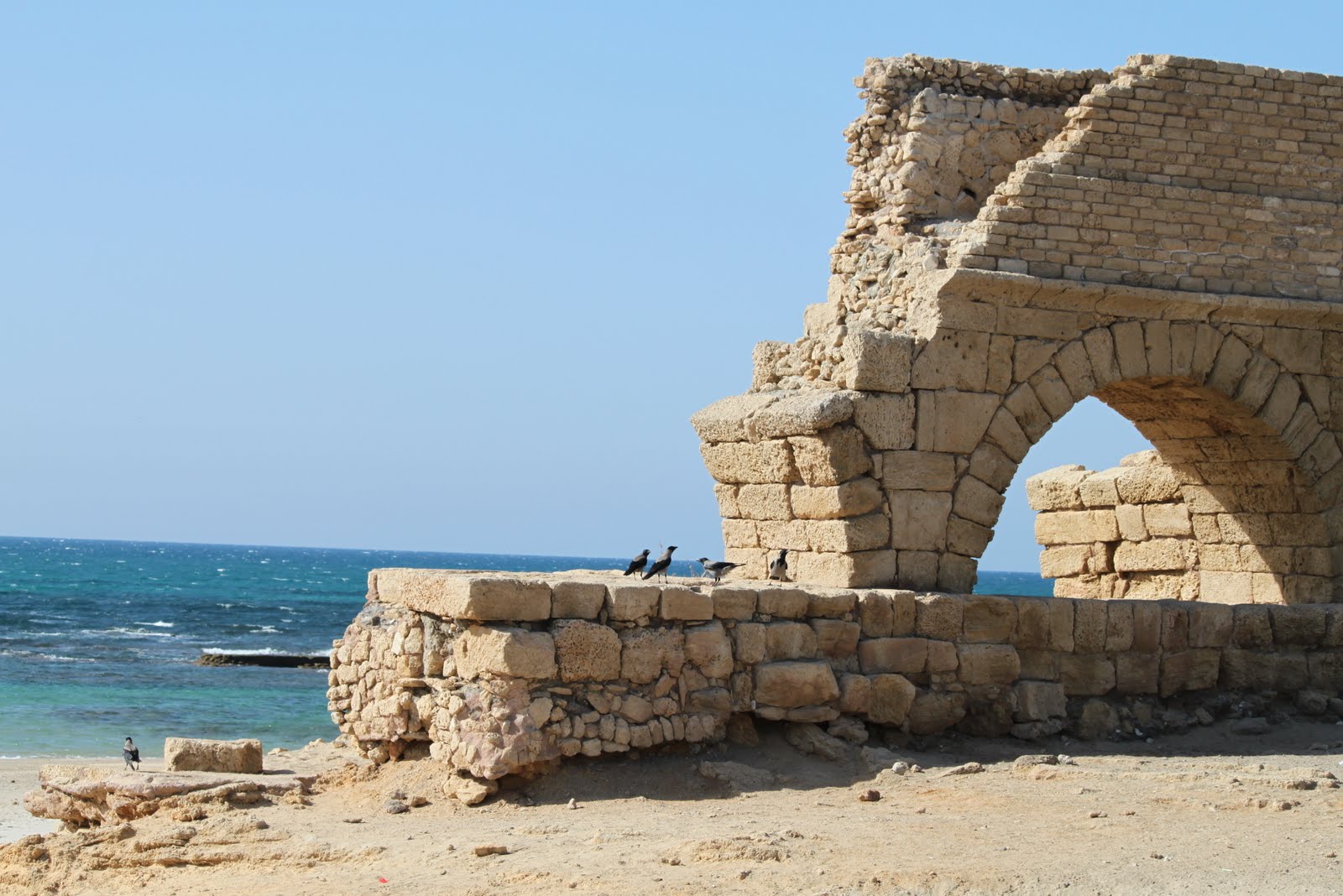
Herod the Great is remembered in history for his stunning and innovative building projects. He built Caesarea Maritima on the Mediterranean coast; the aqueduct and some other structures are still standing. Driven by paranoia, he built two mountaintop fortress-palaces – Herodian and Masada - in case he needed to escape for his life. Herod also designed state-of-the-art water storage cisterns and stone conduits to transfer the water into Jerusalem. But Herod the Great’s crowning achievement was the Temple in Jerusalem. He built a massive and magnificent complex to support and surround the Temple. The Western Wall is a remnant of that structure. (Most of the Temple complex, along with almost all of Jerusalem, was destroyed by Titus in 70 A.D.)

There are many 2,000 year old relics that still exist as testimony to Herod the Great’s building achievements. One day, as I was walking through Independence Park in Jerusalem, I noticed a huge stone reservoir. Turns out that this reservoir, called Mamilla Pool, was a part of Herod the Great’s water supply system. It was linked to the Old City of Jerusalem by an underground channel. It measures 291 feet by 192 feet. It was designed to hold 30,000 cubic meters of water. Another time, as we were walking through the park, a man sat in the (dry) reservoir reading a newspaper. It was a funny sight, but I suppose it was a quiet place to read, there in the ruins of Herod the Great’s handiwork.

But Herod’s personal and political life reads like a bad dream turned into a horrific nightmare. Deceit, murder, and other abnormal behavior defined him and produced sour fruit on his family tree. He ordered the assassination of one of his wives, Mariamne I, and her mother, Alexandra. Two brothers-in-law died as a result of his insane behavior and paranoia: Aristobulus III and Kostobar. In addition, he accused three sons – Antipater III, Alexander, and Aristobulus IV – of plotting against him and they were also executed. Considering Herod the Great’s tendency to kill anyone he considered a threat to his kingship, it is not hard to believe that he ordered the death of innocent children, since he feared that one of them would someday take away his power (Matthew 2:1-19; Luke 1:5).

When we read the Bible, it is easy to get confused when we read the word “Herod” because this title belonged to several different people. Sometimes “Herod” refers to Herod the Great. Other times, it refers to one of his sons or grandsons. For well over 100 years, Herod the Great and his descendants played prominent roles in Israel’s history. When Herod the Great died, his kingdom was divided between three of his sons. Throughout the gospels and the book of Acts, the Herod family is connected to key biblical events.

Here’s a summary of the Herods mentioned in the Bible.

Herod Antipas Matthew 14:1-10; Mark 6:14-28; 8:15; Luke 3:1; 19; 9:7-9; 13:31-32; 23:6-12; Acts 13:1
This is one of Herod the Great’s sons. After his father’s death, he ruled over Galilee and Perea. (Perea is the area east of the Jordan River, in modern-day Jordan.) Herod Antipas is best known for ordering the beheading of John the Baptist.

Herod Antipas’ first wife was Phasaelis, the daughter of Aretas IV, king of the Nabateans in Petra. Herod Antipas divorced Phasaelis to marry Herodias, the wife of his half-brother Herod Philip I. Phasaelis returned to Petra. Shortly thereafter, Aretas IV and his army invaded the territory of Herod Antipas, capturing some of his holdings. Although history does not specifically say that Aretas IV’s invasion of Herod Antipas’ land was because he divorced Phasaelis, it is highly probably that Aretas IV retaliated because Herod Antipas had shamed his daughter and their family.

Because John told Herod Antipas, “It is not lawful for thee to have thy brother’s wife,” Herod Antipas put him in prison. At least on the surface, Herod Antipas liked John and listened to him, “and when he heard him, he did many things, and heard him gladly.” However, Herodias was a wicked woman and, using her daughter Salome, connived a deceitful plan to trick Herod Antipas into beheading John the Baptist.

During Jesus' trial, he was brought before Pontius Pilate. When Pilate found out that Jesus was a Galilaean, he sent him to Herod Antipas, since Galilee was within his jurisdiction. Herod happened to be in Jerusalem at the time and the the Bible says that "when Herod saw Jesus, he was exceeding glad: for he was desirous to see him of a long season, because he had heard many things of him; and he hoped to have seen some miracles done by him."

Was Herod Antipas sincere in wanting to listen to Jesus? Or was he just interested in watching a show of healings and miracles? Earlier in his ministry, Jesus called Herod Antipas "that fox." Perhaps Jesus knew the real intentions of Herod Antipas' heart and so "he answered him nothing." This must have infuriated Herod Antipas, so used to wielding his power and expecting his commands to be obeyed. His initial gladness turned to wrath and he and his men mocked Jesus, placing on him a "gorgeous robe." He could find no reason to sentence Jesus, so he sent Him back to Pontius Pilate.

Herod Philip I Matthew 14:3-11; Mark 6:17; Luke 3:19
This is one of Herod the Great’s sons. Herodias was married to Herod Philip I but decided to leave him and marry his brother (Herod Antipas) instead. He and Herodias had a daughter named Salome. Herod Philip I did not become involved in civil leadership. Perhaps his lack of political ambition is part of what motivated Herodias to seek a more illustrious life with Herod Antipas.

Herod Philip II Luke 3:1
This is one of Herod the Great’s sons. After his father’s death, he ruled over Ituraea and Trachonitis, modern-day Syria. Herod Philip II rebuilt Caesarea Philippi in the northern area of Israel. He married his niece Salome.

Herod Archelaus Matthew 2:22
This is one of Herod the Great’s sons. After his father’s death, he ruled over Judea, Samaria, and Idumea (Edom). During the reign of Herod the Great, Mary and Joseph fled to Egypt to escape Herod the Great’s brutal wrath. When Herod died, an angel appeared to Joseph and told him to return to Israel. But when Joseph heard that Archelaus ruled over Judea, the area that included Bethlehem, he was afraid. Then, “being warned of God in a dream, he turned aside into the parts of Galilee. And he came and dwelt in a city called Nazareth: that it might be fulfilled which was spoken by the prophets, He shall be called a Nazarene” (Matthew 2:19-23). Herod Archelaus ruled for only two years before being banished to Gaul by Rome.

Herod Agrippa I Acts 12:1-23
This is one of Herod the Great’s grandsons. He ruled Galilee, Trachonitis, Perea, and Judea. He persecuted the New Testament church and is especially remembered for the murder of James and the imprisonment of Peter.

Herod Agrippa I sat on his throne and made a speech. People shouted and said, “It is the voice of a god, and not of a man.” The angel of the Lord smote him and he died, “because he gave not God the glory.”

Herod Agrippa II Acts 23-26
This is Herod the Great’s great-grandson, the son of Herod Agrippa I. He ruled over Chalis, in southern Lebanon and was later given authority over other areas as well. Rome issued to Herod Agrippa II the oversight of the temple in Jerusalem, and he was authorized to appoint the high priest.

Paul was being accused of the Jews when he was transferred to Caesarea Maritima for judgment before Felix, the governor of Judah. Felix was married to Drusilla, the daughter of Herod Agrippa I. They listened to Paul, and “Felix, trembled, and answered, Go thy way for this time; when I have a convenient season, I will call for thee.” Felix was sympathetic toward Paul’s plight and was drawn by Paul’s words, but He never relinquished his will and became a Christian. He kept Paul in prison.

After two years, Festus succeeded Felix as governor. He brought Paul before him for trial and Paul was again accused by the Jews. During this time, Herod Agrippa II and his sister Bernice came to visit Festus in Caesarea Maritima. Herod Agrippa II decided to hear Paul himself. Paul described his conversion and concluded his statements with a gripping question directed to Herod Agrippa II. “King Agrippa, believest thou the prophets? I know that thou believest. Then Agrippa said unto Paul, Almost thou persuadest me to be a Christian.”

History tells us that Herod Agrippa II had been raised and educated in Rome. So his sympathies must have favored Rome rather than the Jews, for, during the Jewish rebellion against Rome, he sided with Rome. After Jerusalem was destroyed by Titus in 70 A.D., Herod Agrippa II returned unscathed to Rome, where he lived out the rest of his days.

Herod Agrippa II was the last member of the Herodian dynasty. Four generations of his family had been in direct contact with opportunities to welcome and embrace the Messiah. Herod the Great could have met baby Jesus, but he tried to destroy Him instead. Herod Antipas had personal audiences with John the Baptist. Herod Agrippa I chose to persecute the new church. And Herod Agrippa II was taught by the great apostle Paul. So many opportunities to turn a dysfunctional, mixed-up family into something good. So much rejection of the one thing that could help them.

Herod the Great was not really a Jew. His father – Antipater – was an Idumean. His mother – Kufro – was a Nabatean. History records that Herod the Great spent most of his childhood in Petra.

Idumean was the Greek word for Edomite. Herod the Great and his descendants were actually Edomites.

Herod the Great’s father was forced to convert to Judaism by John Hyrcanus. I asked Rachel, a tour guide at the Second Temple (Herod's Temple) Model, if she considered Herod a true Jew. She did not seem to want to answer but, without elaboration, she abruptly said, “If you’ve converted to Judaism, you’re Jewish.” Yet, the Jews of his time did not like Herod the Great, not just because he was partial to Rome, but because they knew he was not really one of them. The word “Herod” is akin to the word “hero.” Yet the Jews did not consider him their hero. The Pharasaic traditions of that era did not consider forcible conversion legitimate.

So here may be a clue as to why the Herod dynasty was filled to overflowing with not just political intrigue, but personal moral failure of the worst kind. When they converted, it was a political necessity. It was not a heart conversion. Inside, they did not change...even when they encountered the Messiah - the best Jew of all.